


TEOST® Trident
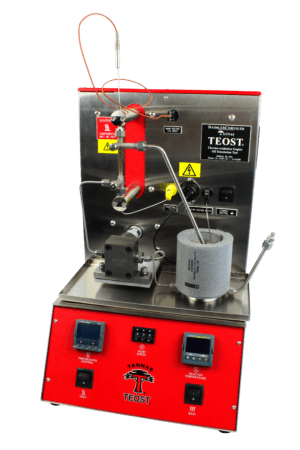
Thermo-Oxidation Engine Oil Simulation Test Test Methods ASTM D6335 | 33C (Chinese SH/T0750) ASTM D7097 | MHT® (Moderately High Temperature) ASTM D8447 | TEOST Turbo®
The three current TEOST® tests operate under temperatures and environmental conditions identified as significant in internal combustion engines to simulate the oxidation and deposit-forming tendencies of engine oils. Oil samples, treated with catalyst, are pumped over a heated steel Depositor Rod on which deposits form. The weight of the Depositor Rod after the test is subtracted from its pre-test weight and added to the particulate weight collected by filtering the remaining oil. The results are reported in milligrams.
In the mid-1980s, Savant Labs developed a unique two-stage oxidation/deposition test technique for engine oils formulated for high-temperature performance. Joint cooperation with Chrysler Corporation resulted in a modified, very high temperature cyclic technique successfully applied to oils blended for turbocharger lubrication temperatures. The technique, known as TEOST® 33C, became ASTM D6335, and Savant Labs received a Chrysler Technology Award in 1993.
Additional work proved successful in modifying the TEOST® to measure deposits on a thin-film of circulating oil. This lower, but constant temperature application, correlated to the piston ring belt area of the combustion engine. The TEOST MHT® (Moderately High Temperature) protocol later became ASTM D7097. International engine oil specifications now include both 33C and MHT®.
As engine designs have evolved over the years, particularly turbochargers, the need for an additional modification to the TEOST® platform became evident with the trends in increasing oil change intervals, improved fuel efficiency, and longer residence times for turbocharger cooling. Development began in 2017 on a new lower-temperature, high-duty cycle deposit test to accurately assess deposit formation in modern engines. This technique, known as TEOST Turbo®, became ASTM D8447 in 2022.
